Postpartum exercise: How to get started with exercise after pregnancy

Lucy Abrams-Husso

Dr. Genevieve Steele

Follows NC° Editorial Policy
At Natural Cycles, our mission is to empower you with the knowledge you need to take charge of your health. At Cycle Matters, we create fact-checked, expert-written content that tackles these topics in a compassionate and accessible way. Read more...
Key takeaways:
-
Changes to your body during pregnancy and after giving birth can affect how it feels to be active for weeks or months after your baby is born
-
If you feel up to it, most doctors recommend starting pelvic floor and gentle core activation exercises in the first days after giving birth to help with healing and recovery
-
While light or low-impact exercises can be started very soon after giving birth for most women, it’s advisable to wait at least 6 weeks before starting high-impact, high-intensity workouts
On this page
- When can you start working out after giving birth?
- Benefits of postpartum exercise
- Exercise and breastfeeding
- Types of postpartum exercise
- Postpartum exercise tips
- 5 at-home postpartum exercises you can try
- Pelvic floor training
- What to look out for during postpartum exercise
- Finding support during your recovery with Natural Cycles
If you are looking to start or return to exercise after having a baby, you might be unsure when it’s safe to begin and how to get moving. In this article, we’ll cover some of the basics of postpartum exercise. It’s important to remember that pregnancy and childbirth changes each body differently, and each person’s recovery is unique. It’s important to always listen to your body, and do what you feel is best for you.
When can you start working out after giving birth?
Everyone’s journey is different, and the answer to this question depends on a number of factors. If you gave birth vaginally, your pregnancy and delivery were uncomplicated, and you feel ready to begin some gentle exercise, doctors generally consider it safe to do so. However, if you had a c-section, have stitches, or your birth was more complicated in any other way, talk to your nurse, midwife, or OBGYN for advice on when to start exercising safely [1]. Because every body (and every birth) is different, there is no set “go” date to start back with higher impact exercise. Guidelines differ greatly, with some advice suggesting waiting up to twelve weeks, and other guidelines proposing a six-week transition back to postpartum exercise [2].
The most important thing is to discuss with your postpartum care team. When you are ready to start back, make sure you begin working out gradually to build strength and endurance before engaging in high-intensity training. For some people, the transition back to being physically active can take longer — it really depends on what’s right for you and your body!
It’s also important to remember that having a baby changes your body, and these changes can be different for everyone. For example, it’s common for the abdominal muscles to separate during pregnancy, regardless of how you deliver. This is known as diastases recti abdominis, caused by your growing baby and uterus pushing the muscles of your abdomen apart [3]. The amount of separation, and how long it takes for the muscles to come back together, can vary. While diastases recti does not prevent you from exercising, you might find that your stomach muscles and lower back muscles are weaker than before pregnancy [4]. If you’re thinking about returning to exercise, it’s good to start with simple exercises that gently engage your core muscles [5].
Finally, during pregnancy, your body releases the hormone relaxin, which loosens your muscles, joints, and ligaments to accommodate your growing baby and prepare your body for birth. Relaxin continues to affect you as you recover postpartum, especially in those first few months. For this reason, it’s especially important to warm up your muscles before beginning a workout, begin exercises gradually, and stretch gently so as to avoid injury. [4]
C-section
Deliveries via c-section have a different recovery path than vaginal births. Most women who have a c-section stay in the hospital for at least a day or two, and you might need to take it easy for several weeks while the wound heals. Though you are encouraged to be mobile and active, most midwives and doctors advise keeping all activity very gentle. While walking is encouraged, anything more strenuous is usually not advised until you’ve consulted with your doctor or midwife [6].
Vaginal birth
Vaginal deliveries can vary widely, as can the recovery period. During a vaginal birth, the perineum, which is the area between the opening of the vagina and your anus, naturally experiences significant stretching and sometimes tearing. Some wounds heal naturally, while others require stitches that can take weeks or months to dissolve.
If you gave birth vaginally, doctors encourage beginning pelvic floor exercises as soon as possible to help circulation, healing, and swelling. You can begin other types of low-intensity exercise whenever it feels comfortable for you. It’s best to start slowly, building strength and endurance over time, and always listening to your body. [5]
Benefits of postpartum exercise
Exercise after having a baby will look different for everyone. Any exercise, regardless of intensity, has been shown to improve both mental and physical health for new moms. In addition to strengthening important muscles that might have weakened during your pregnancy, exercise will help support your new-mom life – lifting and carrying your growing baby, boosting your energy, relieving stress, and encouraging better sleep [1].
Exercise and breastfeeding
This advice also applies if you are breastfeeding or pumping. Research has shown that exercise doesn’t cause any negative side effects to breastmilk supply or composition – nutrients, minerals, and fat. Very high-intensity workouts might increase the lactic acid in breastmilk, which can affect the taste. If you find that your baby doesn’t want to breastfeed immediately after you exercise, try feeding them before working out or waiting at least a half hour after your workout. [7]
Feeding your baby or expressing milk before working out can also alleviate discomfort that you might experience if your breasts are too full [1]. If you are breastfeeding or pumping, it’s especially important that you stay hydrated, drinking plenty of water during any workout.
Types of postpartum exercise
Every and any form of moving your body is considered beneficial, whether it’s at home, outside, or at a gym. Doctors recommend around 2.5 hours, or 150 minutes, of exercise every week [1]. If you’re looking to get started on a new routine or trying to return to your pre-baby regimen, here are some recommendations on how to get started.
Swimming
Swimming, water aerobics, and water jogging are great, low-impact ways to build strength after having a baby. Medical guidance recommends, however, that you wait to get into the pool until at least a week after any postpartum bleeding has stopped [2].
Running and walking
Walking is one of the best ways to begin moving again while recovering postpartum. As soon as your pain and discomfort allows, getting outside and going for a walk is great for your mental and physical health. Remember to start slow, working up your pace and distance gradually as it feels comfortable.
Starting or returning to running, because it’s higher impact and more aerobic, will depend on your own postpartum recovery. It’s generally advised that you try to prepare your body for running by doing other exercises, particularly ones that exercise your pelvic floor and core muscles. You can check the readiness of your pelvic floor by coughing or jumping with a full bladder [8]. If you can do it without any urine leaking, you are probably ready to go.
Yoga & pilates
Yoga and pilates are both great for improving flexibility and strength. Depending on the style, they can also be super for relaxation, meditation, and stress relief. While there aren’t strict recommendations on starting either, it’s important to remember that your abdominal muscles might not be ready for certain poses and postures right away. Try starting with postnatal yoga and pilates courses, which are specifically intended for postpartum recovery. If you prefer to practice these from the comfort and convenience of your own home, there are great resources out there for online workouts.
Strength training
Strength training – body weight training, resistance bands, free weights and weight machines – can vary tremendously in terms of intensity and impact. In general, health professionals advise starting or returning to strength training postpartum slowly and gradually. Like running, strength training is considered a higher impact activity and it’s a good idea to check the strength of your pelvic floor for leakage before heading to the weight room. Be sure to check in with how you’re feeling throughout your workout, staying clued in to the differences in pain or soreness coming from strengthening your muscles versus any injury or healing from childbirth.
Postpartum exercise tips
-
Take it slow to start: when you first return to exercise after giving birth, it can take time to build your endurance back to where it was before getting pregnant. Beginning with simple exercises to strengthen major muscle groups, like your core and back, is a great way to get started.
-
Get the gear right: pregnancy and giving birth changes our bodies in many different ways. You’ve probably noticed changes to your bra size, but changes to your feet are also common [9]. If you are returning to exercise, check and make sure that your sports bras and shoes are well-fitting and supportive.
-
Be kind to yourself: it can be difficult sometimes to find the motivation to work out in the best of times, let alone when you are tired and might not be feeling completely yourself. Try to remember that any activity that engages your body and slightly elevates your heart rate counts. Taking it slow and being consistent are the best ways to make a new exercise plan stick.
-
Set realistic goals: with all the changes your body has undergone during pregnancy and postpartum, it can be challenging to figure out how best to get started exercising again, and what it will feel like for your body. Postnatal classes and exercises can be a great way to check in on your major muscle groups and help you build a routine that meets you where you are.
-
Focus on form: it’s important to remember that back and core muscles can be weakened after pregnancy and childbirth. Paying particular attention to your form and posture when exercising can help you build strength and avoid injury.
-
Stay hydrated: when you are tired or breastfeeding, it’s especially important to stay hydrated. When exercising, even if out for a walk, remember to pack a water bottle.
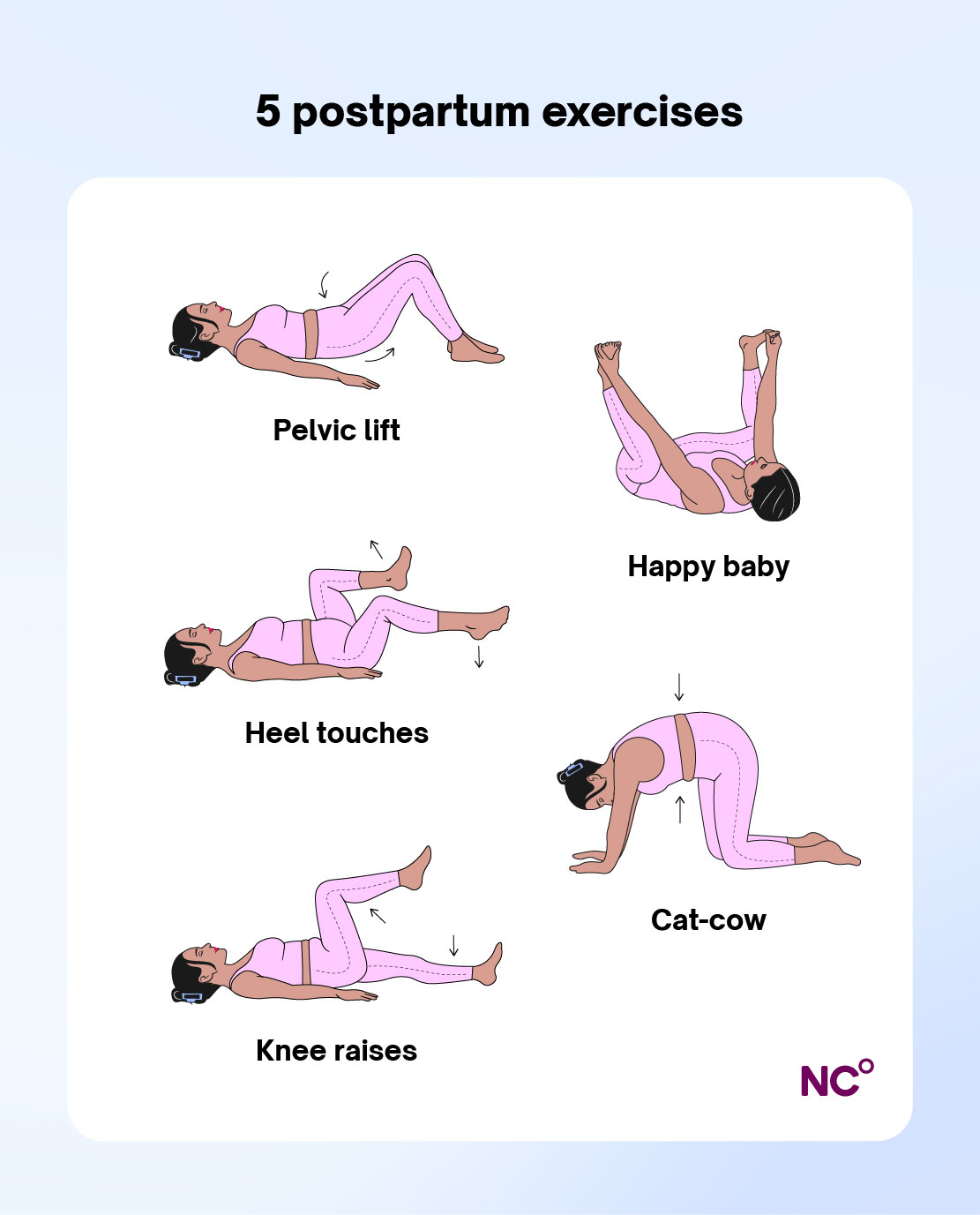
5 at-home postpartum exercises you can try
1. Pelvic tilt
Pelvic tilts are a very gentle way to begin engaging and strengthening your abdominal muscles postpartum. Lie on the floor on your back with your knees bent and feet flat on the floor. Next, try to use your abdominal muscles to press your lower back flat against the ground and tilt your pelvis slightly upwards. Hold this position for about 10 seconds, then gently release. Try repeating five times, increasing to 10 or 20 repetitions over time.
2. Happy baby
This gentle yoga pose helps stretch and relieve tension in the hips, inner thighs, hamstrings, and lower back while strengthening your arms, shoulders, and core muscles. Lie on your back with your spine straight and relaxed. Hold your ankles, shins, or feet, pull your knees to your chest, and open your knees slightly wider than your hips. Keeping hold of your feet or ankles with your arms inside your knees, bend your knees so that the soles of your feet face the ceiling. You can use your arms to help spread your legs apart, stretching your inner thigh muscles, and gently rock side to side.
3. Heel touches
This is another core and lower back strengthener. Lie with your back on your foot, knees slightly bent, feet flat, and palms gently facing down on either side of your hips. Engaging your core muscles, raise both legs up so your shins are parallel to the ground and your knees are together and square over your hips. Keeping your abs engaged, lower one bent leg and gently tap your heel on the ground, and bring it back up. Then do the same heel tap with the other leg. Keep breathing normally, completing as many reps and sets as you feel is right for you.
4. Cat cow
Another pose taken from yoga, cat-cow is great for back and spine mobility, improving circulation, and stretching the front and back body. Start on your hands and knees with your wrists squarely under your shoulders and knees under your hips. Start with cow pose by dropping your stomach towards the floor, lifting your chin and chest, and gently looking up towards the ceiling. Keep drawing your shoulders away from your ears. Transition to cat pose by pulling your stomach back towards your spine, rounding your back, and letting the top of your head fall towards the floor. It’s important to keep the movement relaxed, avoiding forcing any extreme arching in your back or tension in your neck.
5. Knee raises
Knee raises are a great, low-impact way to engage and strengthen core and lower back muscles. Lie on the floor on your back with your knees slightly bent and feet flat on the floor. Raise one leg so your knee is above your hip and straighten the opposite leg out on the floor. Stay in this position, engaging your abdominal muscles to hold your legs steady, continuing to breathe slowly and deeply. Return to the starting position and repeat with the opposite leg. Start small, and do as many reps as feels comfortable for you.
Pelvic floor training
Your pelvic floor muscles are a group of muscles that support your bladder, uterus, and bowel. During pregnancy, your growing baby places tremendous pressure on these muscles, which can also stretch during childbirth. One sign of weakened pelvic floor muscles is if you leak urine when laughing, coughing, or sneezing, or if you feel pressure or heaviness around your vagina.
Strengthening these muscles is really important and can be done safely after giving birth as soon as you have peed on your own and your pain is under control [5]. You might already be familiar with pelvic floor exercises, if you did them while you were pregnant. They can be done lying on your back or side, or while sitting or standing.
Pull your bottom in, like you’re trying not to pass gas, and squeeze the area around your vagina, like you’re holding in your pee or squeezing during sex. You can do long (not more than 10 seconds) or short holds, or squeezes. Repeat until you feel the muscles getting tired, and try to work up to doing sets at least 3 times per day. [3]
What to look out for during postpartum exercise
There are a few things to keep an eye on if you’re worried about overdoing exercise after giving birth. The first is if postpartum bleeding gets heavier or changes color during or after activity. This might be a sign that your workout was too intense. Also, if you feel any pelvic or abdominal pain or discomfort, try to ease off and incorporate more pelvic floor and gentle core exercises into your routine. Pain and discomfort can be a sign that your body might not be ready yet for a particular activity or workout. [4]
If you ever have a question about exercising postpartum, or are unsure if an activity or workout is recommended for you, it’s important to talk to your doctor, nurse, or midwife. Every postpartum journey is different, and it’s important to get guidance specific to you.
Finding support during your recovery with Natural Cycles
Thanks for reading! We hope you now have a better idea of when you can start working out after giving birth. Each woman's postpartum journey is unique and recovery is not a straight line. If you are looking for more support, did you know that Natural Cycles can help? NCº Postpartum is designed to support you after giving birth with daily check-ins to monitor your symptoms, guides and messages with practical tips, and a whole library of articles to help you learn about postpartum recovery.
Did you enjoy reading this article?
Frequently asked questions