Female ejaculation: What does it look like & how to do it

Karolina Wilde

Agathe van Lamsweerde

Follows NC° Editorial Policy
At Natural Cycles, our mission is to empower you with the knowledge you need to take charge of your health. At Cycle Matters, we create fact-checked, expert-written content that tackles these topics in a compassionate and accessible way. Read more...
Key takeaways:
-
Female ejaculation is a release of whitish, milky liquid from the urethra during arousal or climax
-
The liquid is produced and released from Skene’s gland, known as the “female prostate”
-
Contrary to what some people say, not urine — it smells very differently and tastes sweet
-
Female ejaculation and squirting are often used interchangeably, but they’re not the same thing
On this page
- What is female ejaculation?
- Is female ejaculation the same as squirting?
- How common is female ejaculation?
- Where does female ejaculation come from?
- What does female ejaculation look like?
- How much ejaculate comes out?
- What does female ejaculation feel like?
- Want to experience female ejaculation? Here's what to know
- Are there any health benefits?
- Are there any risks or disadvantages?
- Know your body better
Female ejaculation has been mentioned across various cultures for over two thousand years. It was already mentioned in a fourth-century Chinese text titled “Secret Instructions Concerning the Jade Chamber,” yet there’s still much we do not know or understand about it [1]. Just like many things related to female sexuality, it’s greatly underresearched to this day. In this article, we’ll look into what female ejaculation is, what it looks and feels like, and how to explore it if you’re curious.
What is female ejaculation?
Female ejaculation is the expulsion of a creamy, white liquid from the urethra (female urinary tract) that happens when some people are aroused or have an orgasm as a response to sexual stimulus [1].
Is female ejaculation the same as squirting?
The terms “female ejaculation” and “squirting” are often used interchangeably, even by researchers, and many people think of them as the same thing. However, these two phenomena are now thought to be distinct. The two differ both in how they look, and the amount that’s released— female ejaculation liquid is milky, whitish, and the amount expelled is typically between 1 and 5 ml, depending on the source, while squirting liquid is clear or yellowish, and the amount expelled can be up to 10cl. The sources are also different. Female ejaculation liquid is released from the Skene’s gland, while squirting liquid comes from the urinary bladder [2].
What they both have in common, though, is that they both typically happen due to orgasm or sexual arousal.
How common is female ejaculation?
It’s hard to say exactly how common female ejaculation is. Most research places the figure somewhere between the wide range of 10% and 54% of individuals who have experienced it [3]. The challenge with these estimates is that they’re often based on self-reported data, which can be unreliable given the widespread confusion between female ejaculation and squirting. Many studies group these as the same phenomenon or rely on participants’ own interpretations, which can cause confusion about what’s being measured.
For example, a recent study on female ejaculation found that 58% of respondents to an online questionnaire had experienced it, but respondents were recruited among the Swedish population based on interest, and the researchers explicitly noted that the study was not designed to measure the prevalence of female ejaculation. An added challenge is that in the study, researchers combined female ejaculation and squirting into one phenomenon [4].
Due to these limitations, it is difficult to provide precise estimations on how common female ejaculation truly is.
Where does female ejaculation come from?
The liquid expelled during female ejaculation comes from the Skene’s glands [1], which are composed of two pea-sized glands flanking the urethra on the frontal vaginal wall. These paraurethral glands empty the ejaculate liquid into the vestibule. Skene’s glands are often referred to as “the female prostate” due to its similarities to male prostate tissue [4, 5].
What does female ejaculation look like?
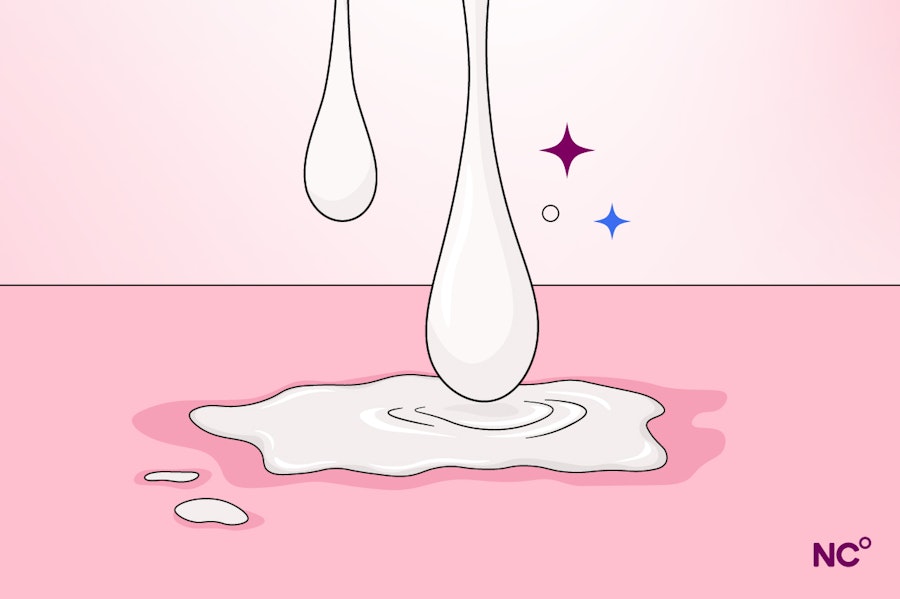
The female ejaculate is often described as having a whitish, milky color and thick consistency [6]. It differs from the liquid released during squirting, which typically has a more yellowish hue.
Does female ejaculation have a smell or taste?
There’s not a lot of documentation that looks specifically into the taste or smell of the female ejaculate. But it has been said that it tastes sweet and doesn’t smell like urine [6]. Because of its consistency and small amount released during arousal, it can easily be mistaken for increased vaginal lubrication.
How much ejaculate comes out?
During female ejaculation, the amount of liquid that comes out is small, typically between 1 to 5 milliliters according to the latest estimations [2]. Because it’s released at the same time as vaginal lubrication during sex, and has a thick, whitish look, it’s easy to miss.
What does female ejaculation feel like?
The way female ejaculation may feel varies from person to person. Reports suggest the experience varies widely, from deeply pleasurable to barely noticeable. Because female ejaculation amounts to such a small amount of fluid, women may not even realize it has happened, experiencing it simply as increased wetness during orgasm [2, 7].
Orgasm accompanied by female ejaculation may feel distinctly different from clitoral orgasm. Pioneering sex researcher Beverly Whipple, who has studied this phenomenon for decades, found that women described it as feeling "deeper inside the body" [6]. Other descriptions present it as a profound sense of release and full-body satisfaction [8].
It’s worth noting that ejaculation doesn’t always happen alongside an orgasm. Some women experience it without reaching climax, while others experience an orgasm without ejaculation [4, 6.
Does it connect with the G-spot?
In the research literature, the G-spot is closely linked to female ejaculation. Researchers Whipple and Perry, who were part of the research group coining the term “G-spot,” found that stimulating the sensitive area on the anterior vaginal wall triggered both ejaculation and a specific type of orgasm in many women known as G-spot orgasm [6].
However, more recent research challenges the idea that G-spot stimulation is the only route. Studies from Påfs observe that clitoral stimulation alone can trigger ejaculation in some women [4], which suggests that it’s less about specific area stimulation and more about a broader network of tissues that responds to sexual arousal. Though it’s crucial we note that Påfs combines female ejaculation and squirting into one, which makes it harder to figure out what triggers female ejaculation alone.
Want to experience female ejaculation? Here's what to know
Trying new things in the bedroom can be fun. If you’re curious to see how female ejaculation happens and how it feels, we have a couple of tips that may help you explore it:
-
Remove the pressure: When we expect things to happen, they sometimes evade us. Especially orgasms. Try to approach this as exploration and getting to know your body better, rather than “I need to achieve female ejaculation.” Removing pressure and expectations allows you to be in the moment and experience the sensations, which may or may not lead to new forms of pleasure.
-
Relax into your body: Relaxation is key here! Take a hot bath or shower, play sensual music, light some scented candles, or do whatever helps you unwind and get in the mood to play.
-
Strengthen your pelvic floor: A strong pelvic floor helps enhance pleasure. You may want to consider different ways to strengthen your pelvic floor, such as taking Pilates or practicing Kegels. Make sure you’re being careful and follow proper guidance when training your pelvic floor muscles. They’re sensitive, and it’s easy to overtrain, which may cause issues.
-
Explore the G-spot: As we discussed, some research suggests that female ejaculation may happen due to G-spot area stimulation. Use your fingers (add lube if natural lubrication isn’t enough!) and gently explore the anterior wall of the vagina. You may want to try different motions, speeds, and patterns to figure out what feels most pleasurable.
-
Try blended stimulation: Sometimes, the G-spot stimulation may not be enough. Try dual or triple stimulation instead! While you stimulate the G-spot internally, use the other hand to stimulate the clitoris. If anal play is your thing, you may even want to add a butt plug into the mix to add even more sensations. Play around with it to see what feels the best.
-
Add a sex toy: G-spot-focused toys can be a great way to enhance the sensations. Look for curved toys that are focused on G-spot pleasure. Silicone is a popular choice, and you can find vibrators that offer extra sensations. Alternatively, you can try stainless steel or glass G-spot dildos that are weighted and often come with ridges and various textures that may feel pleasurable.
-
Practice makes it perfect: Chances are, the first time exploring won’t lead to ejaculation. It may take some time and a couple of tries for you to figure out what floats your boat, so to speak. Be patient with yourself and have fun exploring!
If, after trying everything, you can’t seem to experience female ejaculation, don’t get discouraged. We all have different bodies that respond to sexual stimuli in different ways. Ejaculation is not the key, nor is it a must to enjoy sex and have a fulfilling sex life. So, don’t put pressure on yourself to achieve a goal. Instead, focus on enjoying the experience and all the different sensations.
Are there any health benefits?
There’s no conclusive research on the health benefits of female ejaculation. However, some researchers speculate that biologically, the purpose of the female ejaculation liquid could be to protect the body from urinary tract infections (or UTIs). Sexual intercourse increases the risk of UTIs because the urethra and vaginal opening are close, and friction during sex can sometimes push bacteria closer to the urethra. These researchers hypothesize that the female ejaculate, like sperm and saliva, may contain antimicrobial compounds, such as zinc, lactoferrin, and lysozyme, that can neutralize microbes [9]. No findings or research have been conducted to confirm this hypothesis at this time.
We do know that female ejaculation is part of our body’s natural response to arousal and pleasure. If you experience it, there’s nothing to be worried or ashamed about. And if you haven’t noticed it happen, it’s also totally normal. Each of our bodies is unique, and we experience pleasure differently.
What is well-supported by research is that sexual arousal and pleasure can have real benefits for your overall health and well-being. These include:
-
Reduced stress and tension
-
Improved sleep
-
Better self-esteem
-
Increased lifespan
-
Better general health [10]
Are there any risks or disadvantages?
Female ejaculation produces an incredibly small amount of liquid that is often barely visible. Some researchers hypothesize that women could go their whole lives without realizing that they’re experiencing female ejaculation. It might be that some confuse the feeling of wetness with increased lubrication during an orgasm [2, 3, 7]. There are no known physiological risks and disadvantages to the act of female ejaculation in the current research literature.
Know your body better
Understanding your body and menstrual cycle is key to good health and a satisfying sex life. Natural Cycles is the world’s first birth control app, designed to help you understand your body, cycle, and hormones better and provide certified contraception without synthetic hormones. Take our quiz and find out if Natural Cycles works for you.
Did you enjoy reading this article?
Frequently asked questions