Do you ovulate on birth control?

Iona Nelson

Maja Garbulinska

Follows NC° Editorial Policy
At Natural Cycles, our mission is to empower you with the knowledge you need to take charge of your health. At Cycle Matters, we create fact-checked, expert-written content that tackles these topics in a compassionate and accessible way. Read more...
Key takeaways:
- Ovulation is when one of your ovaries releases a mature egg cell, ready for fertilization by a sperm cell
- Most hormonal birth control options prevent pregnancy by stopping ovulation from happening
- While it can suppress your natural cycle, there is no health risk to not ovulating whilst on hormonal birth control, and it is perfectly safe
- There are non-hormonal birth control options available that don’t interfere with ovulation, such as condoms or Natural Cycles
Many of us turn to birth control to help us avoid pregnancy, but how does that impact ovulation? Different methods of contraception work in different ways, but most hormonal methods work by preventing ovulation. In this article, we’ll give you a quick overview of how ovulation works before explaining how it is impacted by birth control, which methods will stop ovulation, and what alternative options are available.
What is ovulation, and how does it work?
To understand how birth control affects ovulation, let’s recap how ovulation works. Ovulation is the release of a mature egg cell from an ovary and is an essential step to conceiving. The process of ovulation — and the rest of the menstrual cycle — is driven by hormones, most notably estrogen and progesterone [1].
Estrogen is the dominant hormone in the first phase (the follicular phase) of your cycle, reaching its peak a day or two before ovulation. This estrogen peak is followed by a surge in luteinizing hormone (LH), which triggers ovulation and a smaller surge of the follicle-stimulating hormone (FSH), which supports the process. Once released, the egg cell is available for fertilization for up to 24 hours, followed by the beginning of the luteal phase [1, 2].
Do you ovulate on birth control?
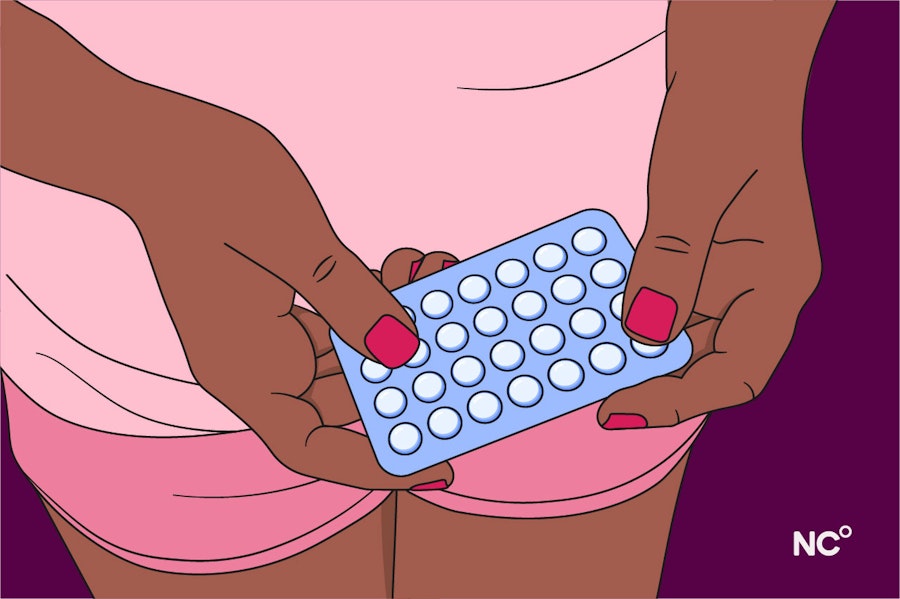
You do not typically ovulate when using some forms of hormonal birth control, such as the combined birth control pill [3]. By preventing ovulation, there is no egg cell available to be fertilized, and pregnancy can’t occur. If you are using non-hormonal birth control, this does not interfere with ovulation.
How does birth control stop ovulation and prevent pregnancy?
Combined hormonal birth control methods, such as the pill, vaginal ring, and patch, contain two hormones: estrogen and progestin (a synthetic progesterone compound). These hormones are released into the body and prevent pregnancy mainly by stopping ovulation, meaning they prevent the release of an egg from the ovaries. They also cause other changes that help prevent pregnancy, including thickening the mucus in the cervix and thinning the lining of the uterus [3]. The birth control shot and implant are progestin-only contraception. The birth control shot and implant work in the same way, but only contain progestin. The mini-pill and the hormonal IUD are also progestin-only contraceptives, but they primarily work by thickening the cervical mucus and changing the endometrial lining. In some users, they will prevent ovulation, but in others, they won’t [4, 5].
What happens if someone doesn’t ovulate?
Without ovulation, your menstrual cycle changes slightly, and you do not have a natural period. If you do experience a period-like bleed while on hormonal birth control, this is called a withdrawal bleed [6]. A common example of this is if you are taking the combined pill and have a seven-day break, during which you experience a bleed.
A withdrawal bleed is triggered by taking a break from the hormones in your birth control, but there is no medical or health need for a withdrawal bleed. In fact, when scientists first developed the birth control pill, the break between packets was included for cultural reasons, to try and mimic a natural menstrual cycle [6]. Whilst a withdrawal bleed isn’t necessary, without it, some people experience breakthrough bleeding and prefer to take a scheduled break to avoid this.
Not ovulating due to hormonal birth control is a normal part of how these contraceptives prevent pregnancy and doesn’t affect your health. It also does not affect your future fertility in the long term, should you choose to stop using birth control [7]. If you are planning to start a family in the near future, it is good to be aware that it can sometimes take time for ovulation to return and your cycle to go back to normal after stopping some forms of hormonal birth control, such as the shot [8].
What birth control methods don’t affect ovulation?
Non-hormonal birth control does not interfere with ovulation and may be a better choice of contraception for those not wanting to take hormones or who may be considering getting pregnant in the near future. Options for non-hormonal birth control include:
- Barrier methods: Condoms, female condoms, the cervical cap, and the diaphragm prevent pregnancy by physically preventing sperm from fertilizing an egg. Condoms are the only form of birth control that also protects you from sexually transmitted infections (STIs) [9].
- Copper IUD: This type of IUD releases copper ions into the uterus instead of hormones. The copper interferes with sperm mobility, making it difficult for the sperm to reach an egg cell, and thins the endometrial lining to prevent implantation if fertilization is successful [5, 10].
- Fertility-awareness methods (FAMs): FAMs are a group of methods whereby you track your menstrual cycle and fertility signs to predict your fertile window — the six-day window in each cycle when unprotected sex can lead to pregnancy [11]. Generally speaking, FAMs are not usually considered effective enough for use as birth control, but typical use effectiveness ranges from 77 to 98% [12]. Depending on the method, typical use effectiveness is often lower than hormonal contraceptive options, as FAMs involve a lot of work from the user and can be affected by external factors such as illness or sleep, leaving a larger window for human error.
- Natural Cycles: The NC° app is the first FDA-cleared birth control app to be used as hormone-free contraception, and unlike FAMs, there’s no need for tricky calculations. Instead, the Natural Cycles one-of-a-kind algorithm uses your biomarkers (skin temperature or heart rate) and unique cycle data to predict ovulation and your fertile window. Compared to popular FAMs like the calendar method, Natural Cycles is more accurate in predicting the best time to have sex to avoid pregnancy and is less likely to show you an incorrect safe day in your app [13].
“People may choose hormone-free birth control for many reasons: they’ve tried a hormonal method before and experienced side effects, they have a history of breast cancer or other hormone-sensitive cancers, or a history of blood clot or significant clotting disorder.” - Dr. Karen Tang, Board-Certified OBGYN & Natural Cycles Medical Advisor
When to see your doctor
Not ovulating due to your birth control is completely normal and safe. But you should speak to a doctor, pharmacist, or healthcare provider if you:
- Experience side effects from your birth control that interfere with your everyday life
- Want to switch birth control methods
- Want to stop taking birth control
- Want to start taking birth control
- Are taking medication that may interfere with the effectiveness of your birth control
- Are trying to get pregnant and have questions about your fertility
- Have had unprotected sex and want to take the morning after pill
Go hormone-free with Natural Cycles
Natural Cycles is effective, hormone-free birth control in the palm of your hand. Seamlessly sync your overnight temperature data with a compatible wearable, and the NC° app will show you a “Green Day” when the algorithm calculates you’re not fertile and can have sex, or a “Red Day” when you are fertile. It is the first FDA-cleared app to be used as hormone-free birth control, using its one-of-a-kind algorithm and your unique cycle data to do all the calculations for you. Natural Cycles is 93% effective with typical use and 98% with perfect use, and doesn’t impact ovulation or your menstrual cycle [12].
Did you enjoy reading this article?
Frequently asked questions