Morning after pill: How to take & side effects

Iona Nelson

Agathe van Lamsweerde

Follows NC° Editorial Policy
At Natural Cycles, our mission is to empower you with the knowledge you need to take charge of your health. At Cycle Matters, we create fact-checked, expert-written content that tackles these topics in a compassionate and accessible way. Read more...
Key Takeaways
-
The morning after pill is a form of emergency contraception, used to prevent pregnancy after having unprotected sex or if your birth control method may have failed
-
There are two main forms of the morning after pill, and both are most effective when taken as soon as possible after sex
-
Side effects of the morning after pill include nausea, spotting, and cramping
-
You can confirm the morning after pill has worked by taking a pregnancy test when your next period is due
Research shows that around one-third of women in their fertile years in the US have taken emergency contraception, such as the morning after pill [1]. But choosing to take emergency birth control can be daunting, and it is important to understand how it works, how effective it is, and the different options available to you. Let’s dive into everything about the morning after pill, including side effects and available alternatives.
What is emergency birth control?
Emergency birth control, or emergency contraception, is used to prevent pregnancy after having sex. It is not recommended as a long-term method of contraception as it is less effective than other contraceptives [2]. Emergency birth control is usually used when you have not used contraception during sex, or when you are concerned your usual contraception method may have failed, such as a condom splitting, a missed birth control pill, or early removal of a diaphragm or cervical cap [3].
Sometimes, emergency birth control is mistaken for being the same as a medical abortion, but this is not correct [4]. Emergency contraception aims to prevent pregnancy before it occurs, whereas a medical abortion ends an existing pregnancy [2].
While the term ‘the morning after pill’ is often used synonymously with the term ‘emergency birth control’, it’s not the only type available. In addition to oral emergency birth control methods, the copper IUD can also be used as emergency birth control. We’ll cover more on that later.
What is the morning after pill?
The morning after pill is the most readily available type of emergency birth control. It is an oral medication that works by using synthetic hormones to prevent or delay ovulation, therefore stopping pregnancy from occurring [5]. It is also referred to as the emergency contraceptive pill or “Plan B”, though Plan B is the name of a specific brand.
There are two main types of morning after pills available. The first contains levonorgestrel, a synthetic progestin. The second option contains ulipristal acetate, a compound that changes how progesterone is used in the body [2, 6]. Levonorgestrel is only effective if taken before the surge in luteinizing hormone (LH), which occurs 1-2 days before ovulation. Ulipristal acetate can still inhibit ovulation after the LH surge [4].
How soon do you need to take the morning after pill?
Despite its name, you do not need to wait until the next day to take the morning after pill. You can take levonorgestrel pills (such as Plan B) at any point up to three days after unprotected sex, and ulipristal acetate pills (such as ellaOne) up to five days after sex. But the sooner you take it, the more effective it is likely to be [7].
What are the side effects of the morning after pill?
Serious side effects of the morning after pill, such as Plan B, are rare. However, you may experience minor side effects, such as:
- Nausea and vomiting
- Cramping, similar to period cramps
- Headache
- Cycle changes, spotting, or irregular bleeding (especially if taken early in the menstrual cycle)
- Breast tenderness
- Abdominal pain
- Dizziness
- Fatigue [4, 7]
If you vomit within two hours of taking the morning after pill, speak to a pharmacist or doctor as soon as possible, as you may need another dose [7].
(Suggested infographic placement)
What are the risks of the morning after pill?
The morning after pill is deemed very safe to take, but there are a few risks to be aware of when taking it.
First, the morning after pill can interact with other medications. This is unlikely a direct health risk; instead, the interactions may reduce the effectiveness of one or both medications [8]. These include medicines to treat tuberculosis (TB), epilepsy, and HIV, an antifungal medication called griseofulvin, some steroid medications, and herbal treatments such as St John’s wort [7]. Make sure you disclose any medication or herbal treatments you are taking to your pharmacist or doctor before taking the morning after pill.
It is also important to understand how the morning after pill can affect your use of hormonal birth control and further risk of pregnancy. If you take levonorgestrel, you can go straight back to using your usual hormonal birth control immediately. However, you still need to use a barrier method (such as condoms) for seven days or abstain from penetrative sex [2]. If you take ulipristal acetate, you cannot resume or begin hormonal birth control (pill, patch, ring, implant, shot, or hormonal IUD) until five days after taking the morning after pill. Use a barrier method or stick to non-penetrative sex until after this time [2].
If you do choose non-penetrative sex, be careful to wash your hands and toys after use, to ensure semen does not make its way into the vagina. In rare cases, this can lead to pregnancy, sometimes known as a “splash pregnancy”.
As mentioned above, the morning after pill is not currently recommended as a long-term contraceptive. Since the morning after pill often delays ovulation, rather than stopping it altogether, it is important that you continue to use other contraceptive methods after taking it. If you get pregnant following taking the morning after pill, it should be of no risk to the developing embryo, according to current research [4].
Emergency birth controls & STIsThough not a direct risk of taking the morning after pill, it is useful to know that emergency contraception does not protect you from sexually transmitted infections (STIs). STIs can be passed from person to person through sexual contact [9]. If you think you are at risk of an STI, you should speak to your doctor or sexual health clinic about testing. |
How effective is the morning after pill?
The sooner you take the morning after pill, the more effective it is [7]. But, like all methods of birth control, the morning after pill is not 100% effective. Research suggests that up to 2 women for every 100 using the morning after pill will get pregnant [7].
The morning after pill may be less effective for those who are overweight. If you have a high BMI, your doctor or pharmacist may suggest the copper IUD instead, which is unaffected by weight [2].
If you are sick or experience diarrhea soon after taking the morning after pill, its effectiveness may be reduced. Refer to the information label with your medication and speak to your pharmacist or doctor as soon as possible, as you may need to take another dose [7].
The time in your cycle when you have unprotected sex determines the overall likelihood of pregnancy occurring. The fertile window is a 6-day period in your cycle during which sex can result in pregnancy. It consists of ovulation — when an egg cell is released from the ovary and survives for 24 hours — and the five days prior, during which sperm can survive in the female reproductive system after intercourse [10]. As the morning after pill works by interrupting ovulation, if you have already ovulated, this type of emergency birth control will not work.
You can learn about your fertile window, ovulation, and which days are safe to have sex and avoid pregnancy by using a specific tracking method, such as Natural Cycles, which is FDA-cleared for use as birth control.
How do you know if the morning after pill worked?
You will know the morning after pill has worked if you get your period. Otherwise, you can take a pregnancy test when the time is right. You can take an at-home test from the first day of your expected period, or 21 days after you have had sex if you are unsure when your period is due [11]. Remember that the morning after pill can cause your period to arrive at an unexpected time [2], and other influences, such as stress, can also delay your period [12].
As for physical symptoms of pregnancy, unfortunately, these cannot be relied upon. Early pregnancy symptoms are very similar to the side effects of the morning after pill or luteal phase symptoms, including [13]:
- A missed period or very light period
- Nausea or vomiting
- Fatigue
- Breast tenderness
- Frequent urination
- A change in taste, smells, and cravings
What other types of emergency birth control are there?
The morning after pill is often the most readily accessible emergency contraceptive, but it is not the only option available to you.
The copper coil (or IUD)
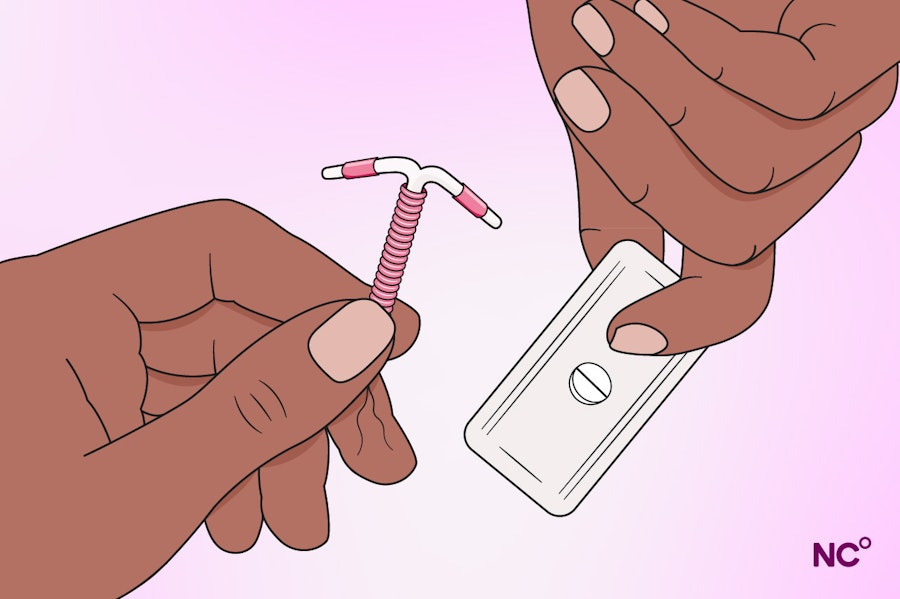
An IUD, or intrauterine device, is a small T-shaped device fitted inside the uterus [14]. There are two types of IUDs; the non-hormonal, copper IUD (or copper coil) is generally inserted as emergency contraception, but recent research shows the hormonal IUD may provide similar protection [15].
The copper coil prevents pregnancy by stopping the sperm from fertilizing the egg [2]. It is more effective than the morning after pill as an emergency contraceptive, and can be used up to five days after unprotected sex [2].
One big benefit of the copper IUD is it also doubles as a long-term contraception method and can be used for up to 10 years [2]. However, the copper IUD must be inserted by a healthcare professional. Keep in mind you may need to make an appointment to access this service, so it’s important you look into this as soon as possible after unprotected sex, if it’s an option you’d like to consider.
Side effects include increased period pains and heavier bleeding within the first few months of use, though this usually subsides within the first year [2]. There is also a very small risk (1 in 1000) of uterine perforation [4].
The combined pill
Sometimes, the combined contraceptive pill may be used as emergency contraception. The combined pill is a hormonal birth control medication containing both synthetic progesterone and estrogen. For use as emergency contraception, you need to take a higher amount than usual, in two separate doses, depending on the brand. As the combined pill is not as effective as the IUD or morning after pill, it is not usually recommended for this use and should only be done so under the guidance of a healthcare professional [2].
Where can I get emergency birth control?
You can purchase levonorgestrel pills over-the-counter at a pharmacy, or through your family planning clinic, sexual health clinic, or doctor. Ulipristal acetate and the copper coil are only available on prescription through your doctor or family planning clinic [2, 7].
Availability of emergency birth control may vary by location, so always check local guidelines or contact your doctor or a pharmacy for more information.
When to see a doctor
You do not need to follow up with a healthcare provider after taking emergency contraception. But it is always worth speaking to your doctor or family planning clinic if you have any concerns about emergency contraception or sexual health, especially if:
- You experience heavy bleeding or pain
- You think you may have a sexually transmitted infection (STI)
- You have a positive pregnancy test
- You are taking other medications or herbal remedies that may interfere with emergency contraception [5]
Know your fertile days with Natural Cycles
Take control of your sexual health with Natural Cycles. Our first-of-its-kind algorithm can be used as a hormone-free birth control, utilizing biomarkers and cycle tracking to predict when your fertile window will occur and what days you can have unprotected sex and don’t need to use protection. NC° Birth Control is 98% effective when used as intended and 93% effective with typical use.
In the NC° app, you can also log emergency contraception use and any symptoms you experience throughout your cycle, such as PMS and cervical mucus. If you wanted to plan a pregnancy in the future, it is easy to switch to NC°Plan Pregnancy.
Did you enjoy reading this article?
Frequently asked questions