Basal body temperature when pregnant: Can BBT detect early pregnancy?

Iona Nelson

Maja Garbulinska

Follows NC° Editorial Policy
At Natural Cycles, our mission is to empower you with the knowledge you need to take charge of your health. At Cycle Matters, we create fact-checked, expert-written content that tackles these topics in a compassionate and accessible way. Read more...
Key takeaways
-
Basal body temperature (BBT) is your body’s lowest temperature, which rises and falls with the hormonal changes of the menstrual cycle
-
If your BBT remains high at the end of your cycle, and your period does not arrive, there is a chance you may be pregnant
-
An elevated BBT can be caused by other factors, such as alcohol or sleep quality, so you should always follow up with a pregnancy test
Ever wondered if you can detect pregnancy in other ways than taking a pregnancy test? In this article, we’re going to take a look at basal body temperature and whether you can use it to confirm pregnancy. We’ll touch on what BBT is and what it looks like throughout the menstrual cycle. We’ll also cover some other ways you can get to know your fertility and explain how Natural Cycles helps couples conceive faster.
What is basal body temperature?
Basal body temperature (BBT) is your body’s lowest temperature recorded after a period of sleep [1]. Since BBT rises and falls at different times in the menstrual cycle, you can use it as a fertility awareness method to track ovulation and your fertile window.
Basal body temperature and your menstrual cycle
Each menstrual cycle begins with the follicular phase, marked by the start of your period. During this first phase, your BBT is low. After ovulation, in the luteal phase, it rises by roughly 0.5-1°F (0.2-0.5°C) [2]. BBT stays high on most days until around the start of your period, when it drops again and your next cycle begins [1].
Basal body temperature when pregnant
The rise and fall of your basal body temperature is a standard part of the menstrual cycle, but this pattern changes slightly if you are pregnant. In the follicular phase, your temperature will be the same as it usually is. Once you ovulate and conception occurs — when a sperm cell fertilizes an egg cell — your BBT will rise as usual, too.
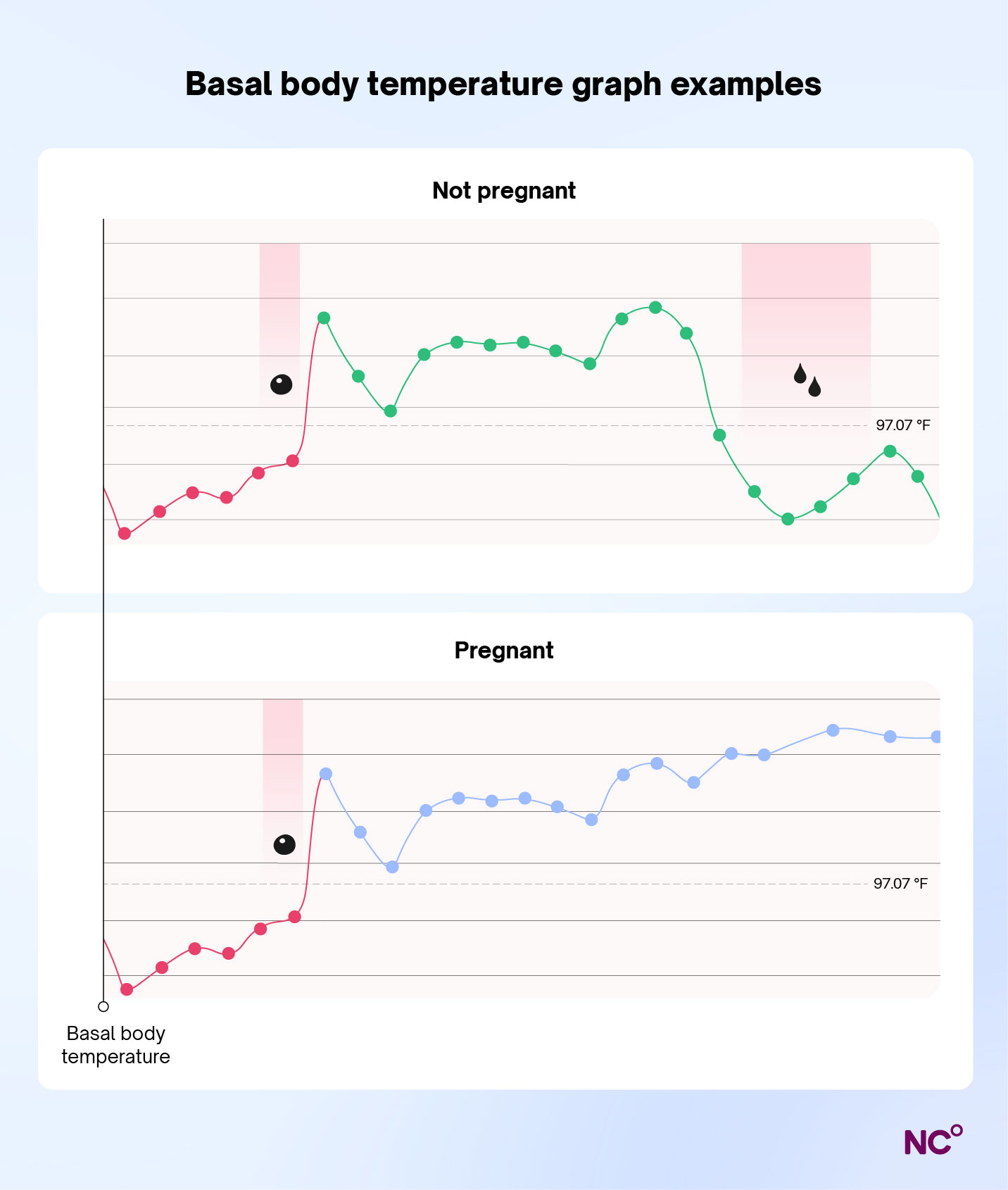
The difference occurs at the end of your cycle: if you are pregnant, your BBT will remain high rather than drop back to its lower level [1]. If you notice your BBT stays elevated and your period doesn’t arrive, there is a possibility you could be pregnant. However, a consistently high BBT does not immediately mean you are pregnant, so always take a home pregnancy test or visit your GP to confirm.
Basal body temperature chart: Pregnant vs not pregnant
To make it easier to visualize the difference between a standard BBT pattern during the menstrual cycle and BBT when you are pregnant, check out the comparison chart below:
Why does basal body temperature change when pregnant?
The answer to this question lies in your hormones. After ovulation, your progesterone levels are high. If you don’t conceive, progesterone levels drop, BBT falls, and your period arrives. If you are pregnant, progesterone levels remain high, your period does not arrive, and BBT stays elevated [2]. Progesterone is a highly supportive hormone in early pregnancy, helping the endometrial lining deliver nutrients to the embryo [3].
How to take your basal body temperature
You should measure your basal body temperature each morning, as soon as possible upon waking, using a sensitive thermometer that displays temperature to two decimal places. To track the pattern in your measurements and their relation to your cycle, take your temperature every morning when you wake up (or as often as you can, at least five days a week) and record it in a notebook or spreadsheet.
Elevated temperature and the absence of an expected period do not necessarily mean you are pregnant. But to know if pregnancy is a possibility, and if it is the right time to take a pregnancy test, you need to know if and when you ovulate. The timing of your period depends on the timing of ovulation. If you ovulate late, your period is usually later, too.
Without knowing when you ovulate — for example, by using your BBT to confirm ovulation — it is hard to know if your period is really late because of pregnancy or if it simply reflects a later ovulation. Knowing when you ovulate can also help you determine when the right time is to take a pregnancy test.
Traditional BBT tracking can be labor-intensive and take some practice. Natural Cycles does the hard work for you, analyzing your temperature data, confirming ovulation, and using your unique cycle data to accurately predict your period and fertile window each cycle. You can choose to measure with a BBT thermometer or one of our compatible wearables: NC° Band, Oura Ring, Apple Watch, or Garmin Watch. Your temperature automatically syncs when you open the NC app, for a hassle-free, seamless experience.
|
Wearable devices work slightly differently from traditional BBT measuring. They continuously track your temperature and heart rate throughout the night, so you do not need to manually take your temperature when you wake up. |
It is also worth keeping in mind that several other factors can also affect BBT, such as alcohol, lack of sleep, and illness. If you are hungover, have a fever, or have had significant trouble sleeping, you should exclude your temperature from your BBT charting [1].
Other signs of early pregnancy
High BBT does not always mean you are pregnant, but you may notice other early pregnancy symptoms, too. Keep in mind that most of these can also be signs of other conditions, such as PMS or other illnesses, so always speak to your doctor or take a home pregnancy test.
-
Missed period: The most easily identifiable sign of pregnancy is a missed period. When you are pregnant, your uterine lining — usually shed during your period — is now supporting the growing embryo [4, 5].
-
Breast changes: In early pregnancy, your breasts may feel sore or tingly. They may also look larger, veins may appear more visible, and your nipples may look darker [4].
-
Nausea: Morning sickness, with or without vomiting, is a very well-documented pregnancy symptom. Despite the name, morning sickness can happen at any time of day [4]!
-
Cravings or aversions: Changes in your tastes, smells, and food preferences may be an early sign of pregnancy. You may feel averse to foods you usually like, crave foods you don’t usually enjoy, feel sensitive to smells, or experience a metallic taste in your mouth [4].
-
Implantation cramps: Implantation is when a fertilized egg embeds into the uterine lining. Anecdotal evidence suggests some people experience light spotting when this happens, known as implantation bleeding, though more research is needed to confirm cause and effect [4].
When to see a doctor
Your doctor can help confirm if you are pregnant, or you can use a home pregnancy test. If you are pregnant and experiencing any pain or bleeding, speak to your doctor as soon as possible, as this can sometimes be a sign of complications. You should also speak to your doctor if you have an existing medical condition or are taking medication that may affect your pregnancy.
Track your fertility with Natural Cycles
Charting your basal body temperature is a great way to get to know your cycle, but it can take a lot of work to record your temperatures manually and determine whether they fall within your averages at each cycle stage. Natural Cycles can do the hard work for you — all you need to do is sleep while wearing the NC° Band (or another compatible wearable) and your body temperature will automatically sync in the NC° app when you wake up. You’ll then receive your fertility status and cycle insights for the day, letting you know exactly where you are in your cycle and if there’s a possibility of pregnancy that day.
Natural Cycles also has different modes depending on your goals. If you are looking to prevent pregnancy, NC° Birth Control is FDA-cleared as hormone-free birth control. If you are trying to get pregnant, NC° Plan Pregnancy will let you know when you are at your most fertile so you can maximize your chances of conceiving. You can then switch to NC° Follow Pregnancy for weekly insights about pregnancy symptoms, guidance, and the growth of your baby. Learn more about your cycle and fertility with Natural Cycles.
Did you enjoy reading this article?
Frequenty asked questions